Quality Management Process
Leopalace21 manages the entire construction cycle--from product development to design, procurement, construction, and maintenance--and has established a system that prioritizes quality assurance to ensure safety and reliability.
Initiatives to Establish a Quality Management System (Restructuring and Establishment of the Quality Management System)
To uphold safety, assurance, and reliability in its construction business, Leopalace21 has fundamentally overhauled its operational management system and strengthened its construction-site-based quality assurance mechanisms.
Based on the Quality Control Manual, we consistently manage the entire construction cycle--from product development, design, and procurement to construction, construction supervision, and maintenance--and through the standardization of approval workflows and checklists, as well as the clarification of standards, we have built a Quality Management System that ensures quality through mechanisms independent of individual personnel.
In addition to construction-site inspections at each stage, the Quality Promotion Department serves as the "1.5th Line" within the "Three Lines Model" quality management system.
By acting as a cross-functional link between the construction site (First Line), the Risk Management and Compliance Department (Second Line), and the Auditing Department (Third Line), the Quality Promotion Department consolidates the issues and risk information identified at each stage.
In addition, by incorporating the results of the review of corrective and preventive measures into our standards, procedures, and operational guidelines, we drive continuous improvement at every stage and in every cycle.
Furthermore, by strengthening the inspection and supervision systems and combining them with multi-layered verification that incorporates an independent third-party perspective, we ensure that any deficiencies or errors are eliminated and maintain rigorous quality management.
By using digital technology to record and visualize these initiatives, and by aggregating and analyzing on-site data, we ensure that the PDCA cycle for problem-solving and risk management functions continuously at every stage, thereby establishing a quality-oriented culture and preventing major risks before they occur through a systematic approach.
(1) Role of Quality Promotion Department (1.5th Line)
We position the Quality Promotion Department as the 1.5th Line within our Quality Management System.
In addition to on-site verification at each process stage, the Quality Promotion Department serves as a cross-functional link between the construction site (First Line), the Risk Management and Compliance Department (Second Line), and the Auditing Department (Third Line), and consolidates the issues and risk information identified at each process stage.
The Quality Promotion Department does not directly oversee construction-site operations; rather, it serves as a hub that organizes and structures the judgments, inspection results, and identified issues gathered from the field, and incorporates them into standards, rules, and operational procedures.
This approach ensures effective, reproducible quality management and governance that is not reliant on leaving matters to the discretion of construction-site individual staff or on personal judgment.
In this way, a key feature of our quality governance is that we have clearly institutionalized the 1.5th Line function that bridges the gap between the front lines (First Line) and the monitoring, support, and oversight functions (Second and Third Lines).
(2) Operational Improvements Based on The Quality Control Manual
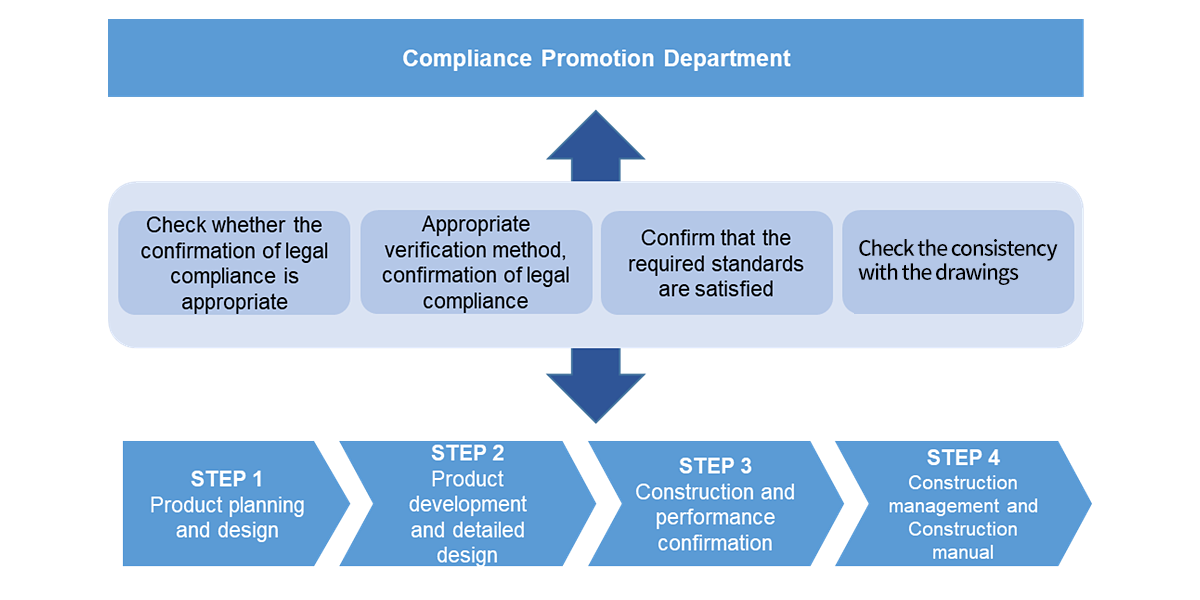
Based on the Quality Control Manual, we define what needs to be verified, who makes decisions and provides approval, and where records (audit trails) are maintained for each stage of the process--including product development, design, construction, construction supervision, procurement, and maintenance--and incorporate these into standard operating procedures.
We incorporate the quality requirements and specifications defined during product development into documents such as construction quality standards, linking them seamlessly to design, inspection, and documentation rules.
We evaluate the results at quality review meetings and revise standards, procedures, and checklists as necessary (Act).
These revisions are rolled out company-wide through notifications and training (Do), with the Second Line auditing operational compliance (Check), and the 1.5th Line leading corrective actions and recurrence prevention measures to be reflected in the next cycle--we run this PDCA cycle on a regular basis.
(3) Clarification of Quality Standards
-
To minimize variations in quality caused by differences in construction site conditions and person in charge, we have established a Construction Quality Standards Manual developed under external expert's supervision.
-
Three Key Features of the Construction Quality Standards Manual
As a practical standards tailored to the specific conditions of each construction site, the manual serves three distinct roles that differ from conventional design documents.
-
01Independence from design documents
It supplements site-specific decision points and finishing details that are not included in standard design documents, serving to fill in the gaps in the design drawings.
-
02Clarifying evaluation criteria
Work procedures, tools required, and inspection schedules are clearly outlined in chronological order. This eliminates uncertainty about how to proceed and supports smooth construction.
-
03Common rules for construction sites
It is a foundation that ensures the same high standards of quality regardless of whether the work is performed by a seasoned craftsman or a junior worker. These are organizational quality control standards designed to eliminate reliance on individual skills.
Seven items listed
-
01Construction standards
Clarify the required performance and acceptance criteria for each component, outlining the goals that must be achieved.
-
02Construction procedures
Standardize the workflow by presenting procedures, tools and inspection schedules in chronological order.
-
03Material specifications
Ensure material quality by clearly defining the specifications, lot control, and storage conditions for the materials and components used.
-
04Tolerance
Define tolerance limits and acceptance criteria for dimensions, surface finish, and fastening for clear criteria for determining acceptance or rejection.
-
05Construction details
Include installation diagrams, key photos, and examples of incorrect installations and corrected versions in the form of visual information.
-
06Inspection criteria
Establish a dual-verification quality control mechanism through self-checks and third-party verification.
-
07Scope
Clarify the scope of application of the standards manual by presenting the applicable construction methods and conditions, as well as a decision-making flowchart for determining exceptions.
(4) Strengthening Inspection and Supervision Systems
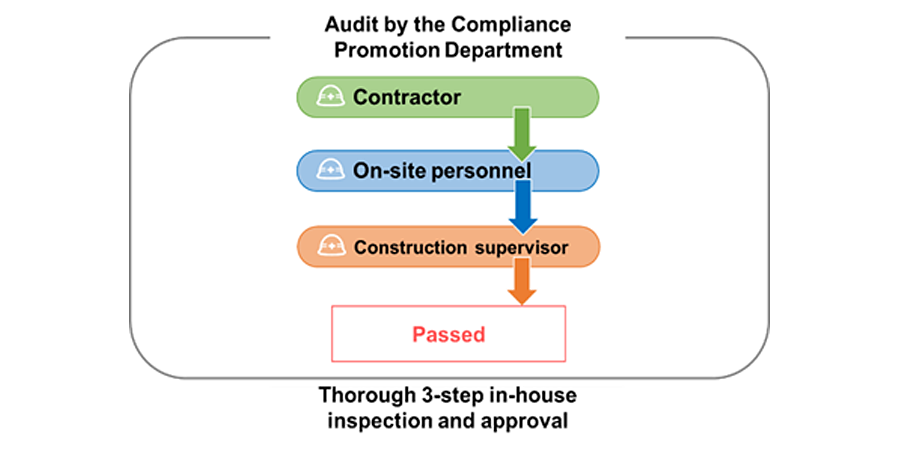
Our standard operating procedure involves a triple-check system conducted by the construction companies, site staffs, and construction supervisors, as well as gate-based approval for the next process. For critical processes, we also incorporate inspections by third-party inspection agencies, and the Risk Management and Compliance Department (Second Line) continuously monitors these operations through process audits.
Furthermore, the Quality Promotion Department (1.5th Line) conducts preemptive monitoring (prior to commencement and before process transitions) based on key management items and a list of potential issues. If a problem is identified, the department becomes involved from the initial response through to the final decision in accordance with the major incident response procedure.
Quality and Safety Management System for Construction Projects
Implement the triple-check system
Strengthening inspection functions through the implementation of a triple-check system involving the construction company, construction manager, and construction supervisor, as well as requiring his approval before proceeding to the next phase of work.
Implement the construction supervision guidelines
Implement strict construction supervision based on the construction supervision guidelines that was established under the supervision of an external consultant in accordance with the Ministry of Land, Infrastructure, Transport and Tourism's guidelines.
Implement the process audits
The Risk Management and Compliance Department audits the implementation status of the triple-check process and the results of third-party inspections.
Revise standard procedures
Revise the standard process by explicitly incorporating the pre-construction preparation period and inspection period into the schedule. For pre-construction preparation, ensure sufficient time is allocated for drawing coordination, site verification, explanation of quality manual, sharing of defect cases, and preparation of the construction plan. For the inspection period, include triple-checking, third-party inspections, corrective actions, re-inspections, and record retention.
Adopt third-party inspections and client site verifications
Adopting a system designed to maximize transparency and reliability through third-party inspections of critical processes (5 items) and client verification (9 items).
(5) Enhancing Quality Control Through Digital Transformation
To ensure construction quality, we are promoting the digitization of inspections and records, making construction-site information transparent and enabling the rapid sharing of corrective actions.
Furthermore, by integrating various digital technologies into our business processes, we manage construction-site verification, documentation, corrective actions, and recurrence prevention as a single workflow.
This allows us to centrally manage revised versions of construction quality standards, inspection checklists, and operational rules, ensuring that updates are reliably communicated.
As a result, we minimize discrepancies in human judgment and communication, maintaining consistent construction quality.
Adopting ANDPAD
We have adopted the cloud-based construction management app ANDPAD to streamline construction management and improve quality.
We centrally manage photos taken at the construction sites, inspection records, schedules, reports, and various communications in the cloud, creating an environment where all stakeholders can always access the latest information.
This reduces risks such as delays in understanding construction-site conditions, missed information, and incomplete records.
By immediately sharing inspection results and corrective actions, we have established an operational framework that enables us to swiftly carry out the entire process--from quality verification to corrective actions and recurrence prevention.
We utilize accumulated data for trend analysis and incorporate the findings into the review of standards and procedures.
As a result, we have established the PDCA cycle in each phase as a continuous improvement process.
- Press release on March 28, 2024:Adopted Cloud-based Construction Management App for Improved Construction Quality and Work Efficiency at Construction Sites
Quality Management: Overview and Operating Model
We have restructured our quality management system to ensure safety, assurance, and reliability across the entire lifecycle--from design through construction to maintenance.
Following our efforts to correct and prevent the recurrence of construction defects, we have resumed construction contracting and have designated quality management as a top priority for the entire company.
Quality is not merely about preventing defects; it is a critical business asset that safeguards brand value, underpins profitability, and provides the foundation for business sustainability.
Our mission is to build a Quality Management System that maximizes customer satisfaction involving the frontline activities.
To achieve this, we have established the Quality Management System (QMP/QTS/QT) based on safety, assurance, and reliability in April 2026.
The Quality Trust Standard (QTS) employs the transparency, reproducibility, responsiveness, and reliability as the measurement criteria. By integrating the clarified measurement criteria with auditing, monitoring, and visualization through digital transformation (DX), we proactively prevent significant quality risks and ensure thorough, explainable quality management.
Furthermore, through the continuous strengthening and improvement of our inspection systems, we will evolve into an organization that consistently demonstrates quality through tangible results.
(1) Make The Quality Trust Standard (QTS) as Internal Benchmark for All Related Processes
Utilizing the QTS as a Common Internal Benchmark
The QTS is a quality standard, that Leopalace21 employs with the following definition.
Quality = Meeting requirements for performance, safety, and accuracy
Trust = Explainable credibility built on transparency and reproducibility
Standard = A unified yardstick for decision-making and operations
The QTS is our common quality standard for trusted quality, integrating these three perspectives.
(2) PDCA Centered on The Quality Trust Standard (QTS)
Implement the Quality PDCA Cycle Based on QTS
With the QTS as the core, we continuously apply the PDCA cycle at every stage--from product planning to maintenance.
This ensures that criteria, procedures, and checklists are regularly reviewed, and improvements are reliably incorporated into the next cycle.
By using QTS as the benchmark, we can organize a company-wide optimized PDCA cycle rather than individual optimization,leading to continuous quality improvement and the maintenance of our trust assets.
(3) Quality Management Throughout the Entire Construction Cycle
Integrated Management of the Construction Cycle
From product planning and development through design, procurement, construction, and ongoing maintenance, we apply uniform quality standard across every stage of the process.
We ensure consistency by breaking down silos between departments and sharing data and standard.
Recording and Visualization Through Digital Transformation
We record and store evidence from each process as digital data.
This enables us to track who, when, and what was verified, thereby establishing a highly transparent management system.
Quality Management Policy (QMP)
Operate systems to ensure safety, assurance, and reliability
- Achieve consistent quality level as an integral part of the organizational mechanism.
- Ensure transparency and accountability through standardized criteria, procedures, and record-keeping.
- Continuously improve quality through corrective actions, preventive measures, and training.
Quality Trust Standard (QTS)
Become a company that continues to be chosen for its quality and reliability
-
A Transparency
Evidence, records, and the basis for judgment are clear and verifiable by anyone.
-
B Responsiveness
Anomalies are detected early enough and promptly corrected to prevent recurrence.
-
C Reproducibility
The same quality level is consistently maintained regardless of changes in personnel or construction site.
-
D Reliability
Improvements accumulate and quality is maintained as a corporate asset of trust.
Quality Theme (QT)
A Transparency
B Responsiveness
C Reproducibility
D Reliability
SERVICE SITES
-
- Clicking the links above will take you to the home page of each site.